An author writes about different perspectives on the time we spend online, and which definitions serve us.
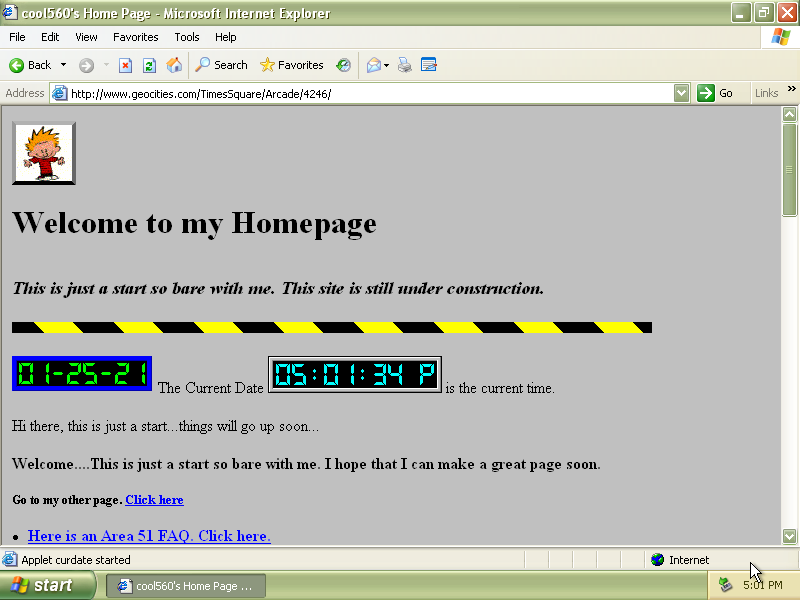
In order to build a personal page on GeoCities, it was first necessary to teach yourself HTML. Given the time required to learn the language and plan the content, pages were often left in a continual state of “Under Construction”. In other words, working on a page mattered more than finishing it. This may seem insignificant, but the phrase “Under Construction” essentially framed the work of constructing and maintaining an online self as manual labour, as tangible and ongoing as repairing a road or building a house. The wording encouraged us to see ourselves not as passive consumers or content generators, but as workers actively building a shared environment. As platforms evolved — and we were reconfigured into users — our labour became invisible.
I appreciate the author’s intention, but she put me off from the very first line by calling what we do here “nostalgia”, then launching into a lot of empty philosophizing. By the same token, everyone in a gift economy is a “worker”. Except the distinction only matters when there are also bosses – an exploiter class. In other words, the entire premise of the write-up is capitalism-pilled by definition. We can do better. We are doing better already.
In fairness I think the reference to nostalgia is referring to something different to what the small web or indie web or web revival movement are doing. It’s definitely an outsider’s perspective. I don’t think projects like the 32 bit café are even on the author’s radar.
I think the emphasis on work and being a worker comes from a specific kind of Marxist political perspective. I was also skeptical about it, but I think it is valuable and thought-provoking to think about work and what kinds of activity are and aren’t work. It makes me think about how many web behemonths rely on unpaid or barely-paid labour to fully function. Hence she argues that they have to convince you that you’re (not) working in order to persuade you to continue to work for them. I don’t know if she’s right, but I think it’s interesting to think about.
I’m too tired to be deep about this but the web shouldn’t be like another workplace. It should be like your local cafe/pub/bar: of course the owner makes money when you buy drinks, you can try to leverage your value as a costumer by threatening to take your business elsewhere, etc. but the main part of it is that it’s a place where you can be yourself and build a community.
The article points out that Geocities was started by a queer man who understood the power of self-expression and finding like-minded individuals; to me, that’s a much more worthwhile perspective when thinking about the future of the web and what it could be.
I realise this is controversial nowadays but things that take effort don’t need to be labour or “work”. People can do things because it’s fun without being tricked into thinking it’s fun. I enjoy reading, book publishers don’t need to convince me that reading is fun just so they’ll make money.
I also agree that “work” isn’t the right word for it. “Work” is transactional, and building websites obviously doesn’t have to be transactional (though it often is). A better term to use here might have been “occupation,” as in the occupational therapy sense of the word:
Occupations are the activities that people do every day to give their life meaning and purpose. Occupations can be done alone or with family members and friends. Occupations can be done at home, at work or school, and in the community.
But, of course, if the author hadn’t framed this as “work,” then she wouldn’t have been able to frame The Haunting (a community boycott, essentially) as a “strike.”
It’s an interesting article overall, but I definitely don’t feel like a “worker” when I’m building stuff for the Internet. I simply feel like a community member who is contributing something that is hopefully of worth (not financial worth, just worth) to the broader community.