I've been making a tool for checking how IndieWeb friendly your site is...

So I’ve been pretty interested in the IndieWeb (obviously), and spreading as much knowledge as possible about the features you can add to your own site to help the cause.

I put together a tool that let’s you scan your website and it checks for various common IndieWeb patterns and features, and if you don’t have them directs you towards where to find out more.

It does require you enter your email address, but I do not store it (lots more details on that below), as I needed to be reasonably sure that the person running the tool was the owner of the website. It isn’t meant for checking others (you could do that manually) - but as a tool for self improvement

Thoughts on privacy, emails, accounts generally...

This bit might be a little rambly, apologies.

I wanted to be reasonably sure the person running the scan was the person who owned the website, and I didn’t want them to have a permanent HTML tag or comment on their site to continue to validate their ownership.

The flow I came up with is as such:

  1. User enters email address and validates themselves by clicking the link they get sent, or entering the code they get sent.
  2. I store a statically salted hash of the email address as an identifier going forward.
  3. The user then enters their website domain and is given a meta tag to place on their site temporarily.
  4. I check the tag exists, and validate the ownership on my end.
  5. The user can then remove the meta tag, and run as many scans as they want.

This lets me be reasonably sure the person owns the website, have no trace of their email address, have no PII between the user and their domain name. If anything were to happen and data be exposed, there is nothing to give away anyone’s information.

That being said, I do this professionally, I have run multiple security tools on the code, and the code is open source (blog on that to follow). We cool.

If you would be interested in beta testing this tool, it’s online now here - https://scan.fyi

I’ve run it on a few websites, but it needs a lot more people to check it out now.

Things I would really like to hear:

  • Does it pick up the features you know you have implemented?
  • If it doesn’t find your RSS feed details, what is the URL to your blog page? I have tried to cover many common ones and whatever foreign language ones I could find, I have absolutely missed some!
  • Are there any other IndieWeb design patterns or features you think I should be checking for and pointing people towards?

Thanks for time, netizens.

4 Likes

The verification requirement limits this tool’s utility. I’d have to add it to pages on my own website just to test my own, and testing others is impossible.

1 Like

Hmm. I will say that I’m not really a huge fan of the idea of assigning a grade to my site based on how well I’ve met IndieWeb benchmarks … but I’m also just turned off by the idea of achieving IndieWeb “levels” in general, so I’m probably not the ideal audience for this tool. :slight_smile: My site will never have Webmentions or IndieAuth, and I’m perfectly OK with that. I’m not the only one who feels that way; based on the IndieWeb wiki, it looks like the entire “IndieMark” concept is under review.

5 Likes

I’m not super into all the different IndieWeb standards, but I’ve done some bits and bobs and would give the tool a go if there wasn’t a bit too much overhead. I’m lazy; I don’t want to bounce via my e-mail account and then have to commit a change to add a meta tag, wait for it to deploy, then reverse the process to remove it :sweat_smile:

It feels like IndieAuth would be a really natural fit here? Enter a domain, see if you can auth the user via IndieAuth, if not fall back to the existing flow? (Bonus: allow TXT records as well as meta tags?)

1 Like

That’s kind of the point, it’s aimed at seeing what you could do, not others.

I guess the grade could be dropped. The amount of people who don’t even know what webmentions are though is very high, so increasing awareness is still important.

A good idea, thanks. I do kind of feel if you have IndieAuth on your site already then the tool probably isn’t going to teach you anything you don’t already know though…

I feel like the major flaw of this is that you are presenting this as a de-facto judge of what is indie web and what is not, even if that is not your intent. This is the kind of thing that runs the risk of confusing new people to the scene that may think this is required to ‘qualify’ as being ‘indieweb’, which simply is not true.

I think this checker is a really useful tool for those that specifically want to participate in interactive webmentions, in which case it feels more appropriate to present it as a webmentions check or verifier rather than a catch-all ‘indieweb’ verifier.

2 Likes

Am I? I thought the wording across the site and my post was that it’s clearly about awareness of what’s available, building blocks, functionality. I think the issue is that there’s a disconnect between what IndieWeb means to everyone individually and that’s fine.

These are all open standards with a wide variety of implementations, if you don’t want to, that’s fine.

Not everything is for everyone.

1 Like

I think that combined with the letter grading system, possibly some of the phrasing used on the tool gives the impression that it’s judging sites on their level of IndieWeb-ness? For example: “Think of it as a friendly health check for your corner of the web” and “An IndieWeb self improvement tool.” The implication is that if your site “lacks” certain technical IndieWeb things (which are, again, already in question on the IndieWeb wiki itself), your site is not as “healthy” as it could be (by IndieWeb standards), and that by using this tool, you can identify the things you need to “improve” on. That might not have been what you intended, but I can see how people might interpret it that way. Perhaps the phrasing just needs to be tweaked a little to emphasize the fact that these are merely optional tech features that don’t in any way determine whether or not your site can be considered “IndieWeb”?

You’re right that there is some disconnect between what IndieWeb means to everyone. Some people emphasize the tech stack side of it, while others emphasize the broad principles behind the IndieWeb (i.e. owning your content). I think it’s important to note one way or another that IndieMark scores are controversial, as they can come across as being a bit gatekeepery; as per the wiki “IndieMark is only one very rough and in-progress developer guide, please do not use it to determine if your site ‘is a member of the IndieWeb’.“

5 Likes

Really good feedback, thanks. I am looking at the wording now to make it clearer on the intentions of the tool - on raising of awareness of things you could considering using or adding.

4 Likes

I tried the service. The first check failed because the crawler got swept up by my firewall, so I had to wait a few minutes to recheck. I think that’s an ample window of time.

While this is a perfect spot for IndieAuth for verification, I don’t think the metatag requirement is a bonkers ask. I think it’s a very reasonable (and low tech) way to verify website ownership.

Overall, I think this is a great all-in-one verification service to check if things are actually broadcasting correctly, and that what’s being sent is correct. It’s also a great gateway into learning about what IndieWeb protocols one could potentially add to boost their overall feature set. Like indiewebify.me, but leveled up. I totally understand the negative “purity test” optics of a rating system, but I always saw that as more aspirational than what should be considered “required”. Some stuff should be strongly recommended, like h-cards on at least the index, but everything else are cool-to-haves, fine-if-we-don’ts.

1 Like

Depending if you’re looking at IndieWeb(.org) and the general description of indie web :slight_smile:

From what I understand, this is grading your website of tools/protocols listed on indieweb.org - so yes, this would be a judge of how IndieWeb your website is. Similar to https://indiewebify.me/

If the idea is pointing people toward a bundle of optional suggestions, how about using language more like “bonus round” or “side quests”? As in, for instance, “Now that you’ve made a website and put it online, would you like to see what else you can do with it? Come browse our fine selection of indie web power-ups.”

1 Like

I think the language changes I’ve made make it clearer on the intentions as a discovery tool now. There’s no grades anymore so it shouldn’t feel like a judgment.

Next is going to be adding more of the less immediately programmatic things, such as keeping a links page to other sites, /now pages, stuff like that.

I’m the target audience for this because I love adding functionality to my site (it’s great procrastination from writing and using my site :stuck_out_tongue:) but all of this is optional and I’d like to see larger, more accessible adoption of certain IndieWeb features.
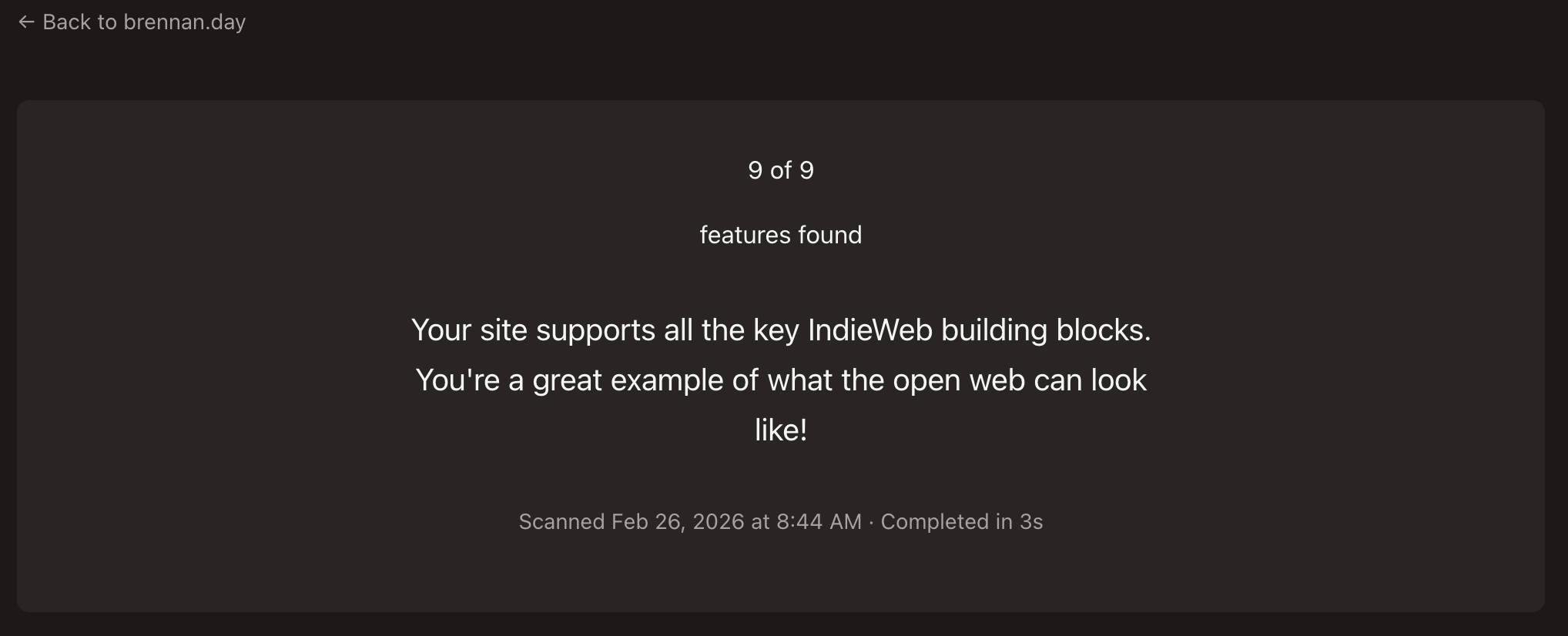
Anyways, turns out I had everything except WebSub (which I haven’t heard of before). Implemented that and now I have nothing else to procrastinate with :smiley:

4 Likes

It is a validator for only one collection of tools listed on indieweb,org but cross-site communication is not a requirement of indieweb dot org. From the blurb on its site:

We are a community of independent and personal websites based on the principles of: owning your domain and using it as your primary online identity, publishing on your own site first (optionally elsewhere), and owning your content.

My website doesn’t use ‘indie auth’, nor do I ever see a reason to use it, and yet my website still covers the 11 principles of indieweb dot org which means it is still within the bounds of indieweb both in colloquialism and the organization itself, even if my site were to get a ‘F’ grade on the checker.

Ritual has already dropped the ‘indieweb grading’ aspect of the checker and cleaned up some of the language which was my biggest contention, but I hope this better illustrates why I brought this up in the first place.

1 Like

None of them are requirements though are they, just the page says, they’re just guiding principles.

Anyway…

1 Like