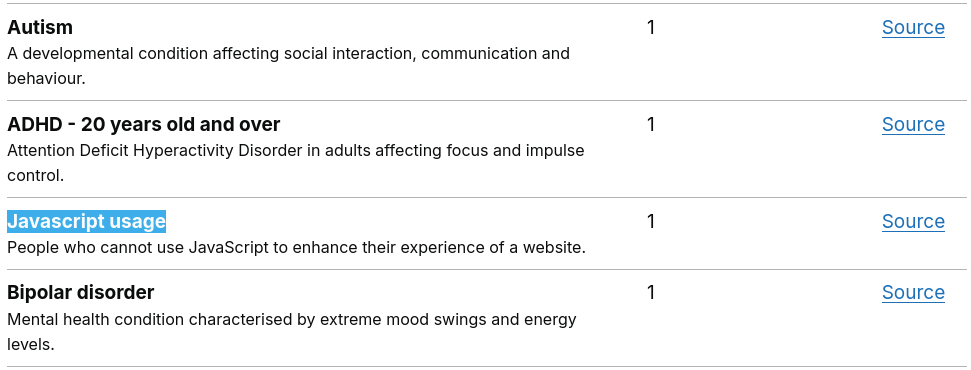
Absolutely should be in the resource list too, and I will add it there later. But I also wanted it to have a dedicated thread for discussion because it does reveal data I don’t think people (generally) realize.
In short: this site, from the UK government, will calculate how many people using your “service” (in our case, visiting your site) that have a disability that may require accommodations. You give it any number, it does the math based on data for you.
I just gave it the number 20, which is honestly a really high guess at how many people visit my site a month. I don’t track that data lol. But it was a nice number to work with. And assuming that 20 people a month do visit my site—16 of them would have vision impairments! One of them being me at this point, I’m always zooming into websites…
This isn’t made for websites specifically, but rather “services” of all kinds. So it’s still up to you as the webmaster to deduce what accessibility features people would need, what is within reason for you as an individual to provide (which I will always argue to be “more than you think, if your site is designed with it in mind from day one”), how to add those features, etc.
But my point is that people don’t realize how common these disabilities are, due to them often not being very visible in public (due to a lack of accessibility, no less) and the numbers here are very eye-opening. And probably easier for the human brain to understand than percentages or “one in 10 people” type phrases.
6 Likes
Interesting to me because I have a lot of these myself, so I certainly hope my site is accessible to others with the same conditions (and others that I don’t have)! I always am aiming for that. My site’s code is kind of a mess because I was learning as I went but I’ve tried my best to keep it accessible. I know it feels intuitive to me and I have a lot of disorders, so I hope that translates.
Ahh, the most debilitating disability of all: Javascript usage.
4 Likes
 “disability” isn’t the best word to describe all cases here—it also mentions cases like illiteracy, limited tech knowledge, and people who only have a phone to access the internet. Not disabilities, but absolutely cases that can impact someone’s ability to use a service (again, in this case, enjoy a website) if it’s not designed with them in mind.
That being said—some people can’t use JavaScript! JS is actactually surprisingly bandwidth hungry. Not an issue for people who have access to high-speed internet, but not everyone has that (100 Rabbits, a group that chooses to live off-grid but still gets internet access sometimes, explains it more). Some people also have cheap, crappy devices that may or may not play nice with JS—or rather, their equally crappy browsers. There’s probably more cases but I think the point’s been made.
(And I do know you were just trying to make a joke! Unfortunately, this context is helpful for the wider discussion at hand, soooo…)
I cracked up at the idea of English a second language being a “disability or condition” hahaha. (I get what they mean, but English is technically not my first language so I found this very funny.)
Very sorry to the 4 Welsh people who are illiterate and can’t read my blog
1 Like