Back when the Internet Phone Book came out, I ordered a copy and subscribed to the Metalabel newsletter. They’ve had some interesting things since then, and I’ve enjoyed checking in when they do send one out (though it’s not that often). Lately they’ve been pushing an idea that they call “Dark Forest OS,” which seems to be a social site that is only viewable to members who have joined.
It’s a little bit difficult to see what it’s like, since there’s nothing publicly available, and that’s by design. Whereas we’re trying to work to create an alternative space on the web where everyone is welcome (except AI), Metalabel is really embracing the “Dark Forest” idea, saying that the way forward is to have protected, private places where people know that their discussions aren’t available to the public.
I’m not sure how I feel about the idea myself, because it’s essentially just a walled garden that’s owned by one company. The main difference is that the ideas behind it are different and not motivated by profit, for now, but those things can change.
I was wondering if anyone here had joined and had thoughts they’d like to share about the experience, or if others had heard and been hesitant to join.
Conceptually, I dislike the idea of communities having to be closed and somewhat hidden going forward, but practically speaking, I understand why it’s necessary for a community to be sustainable.
This is a problem for any online community, whether it’s owned by a company or not. A small amount of people are in control of the infrastructure for the community space, and if they disappear or make alienating changes, the community at best fractures and finds new spaces, or dissipates entirely. The fediverse is probably the closest thing out there to solving this problem, though introduces a bunch of new ones.
We already have dark forests, though. From the very get-go that term was used to describe actually existing places, like private discord servers or group chats.
I get the appeal of dark forests - no influencers or marketers, and social pressure to prevent assholes - but if that was “all” we needed, this and similar projects wouldn’t be needed.
The something that’s missing is porosity. These closed off dark forest groups don’t allow you to discover new people. We aren’t cold DMing our friends’ friends to find new friends, so we have to resort to leaving the dark forest. And we do! We recognize the need to not just be in a handful of group DMs and never meet new people online.
There are some interesting projects attempting to solve the problem of meeting new like-minded people without connecting to the firehouse of strangers, marketers, and influencers. Things like having different communities share a common channel/chatroom, for example. And of course, forums like these, webrings, newsletters, and many more also try to solve this problem. I’m sure a lot of people here are already very familiar with alternatives to the big web/social media
I’m not sure just recreating big social media but with closed registration is actually enough to stem the fire hose. But I’ll try it ig.
This interferes with being able to tell what the site features are – a problem that could be addressed by having a lot of information on the landing page, which there isn’t. Just some marketing fluff about how things are bad these days, a mysterious mention of “shared treasuries” (what?), and a mention of “curated content” (so is someone going through all the posts and deciding which ones to promote to a featured feed or something? what am I supposed to be picturing here?).
Basic questions that remain unanswered:
What do the posts actually look like? Are there reblogs, comments, tags, user avatars, groups, blocks, blacklisting, an edit button…?
What are the moderation policies or terms of service?
Yeah these are all questions I’ve had as well, and I think the answers to them will determine the longevity and success of the project overall.
Hell, I should just take the plunge along with @brennan and see what it’s like first hand! But like you, I’ll be doing it with a hefty grain of salt, because I’m pretty skeptical.
Hey y’all,
I got an email from DFOS today and was able to sign up and create a space. It’s pretty bare bones right now, but wanted to at least let people know you’re able to check it out if you want now.
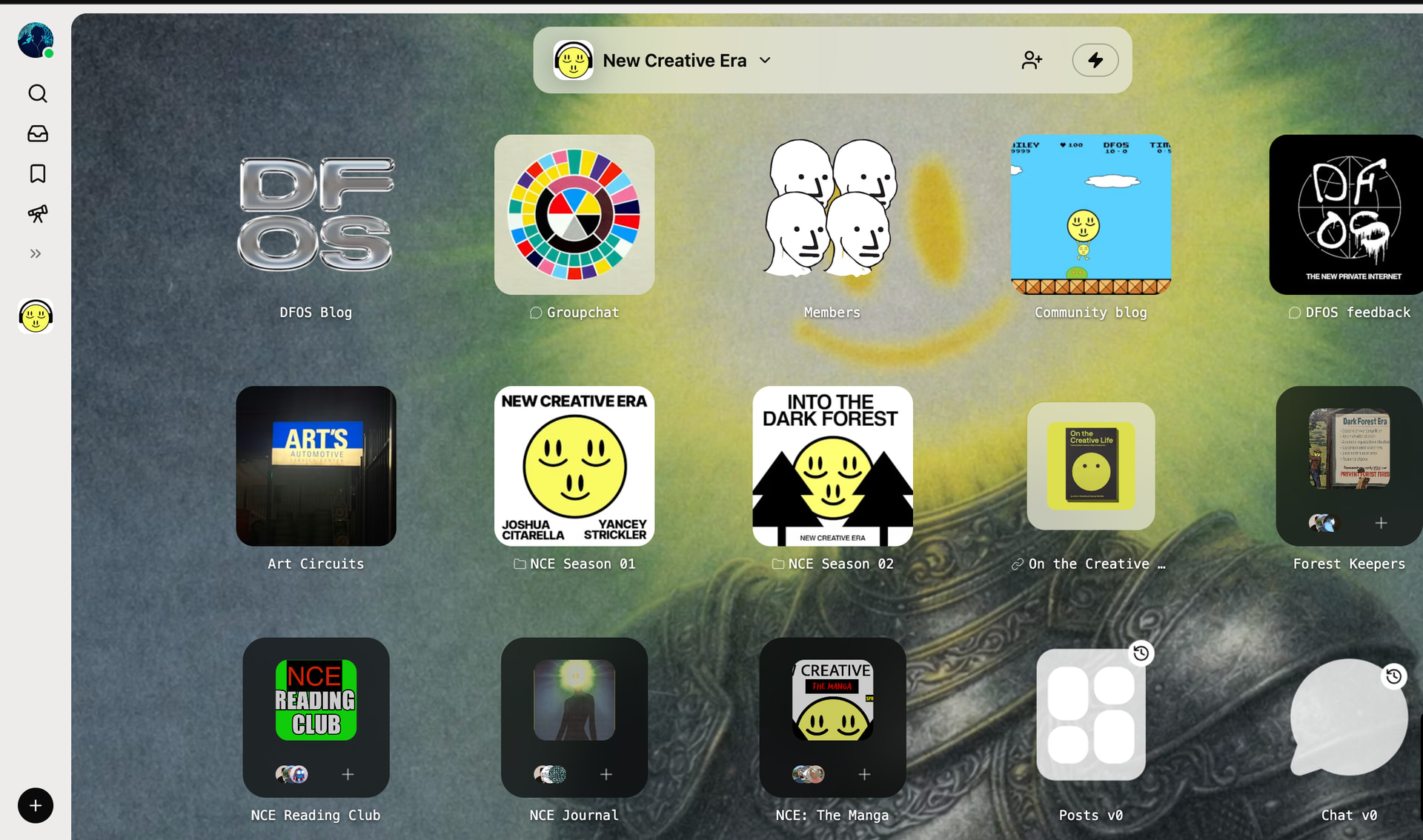
You create a community, which gets a “desktop” where you can include “apps” (currently just the members list, chat rooms, blogs (more like a forum), and links to external pages). Which is a bit nicer of a concept than say discord where you’d have to fit everything into channels.
There’s sub-groups within a community, which can have their own avatar name and color and their own sub-desktop of apps, and can be set to either freely joinable, invite only, or paid access(?). Speaking of money, there’s a “treasury” app coming later. I guess this these would work together to create something like patreon where paying members get special roles/channels. It also supports MCPs (a way of telling an AI model about the community), which is a bit of a turn off for me.
Altogether… Yeah, this is definitely a service for creating dark forests. I guess what sets it apart from all the other dark forests that already exist is that this one seems a bit more oriented on solving the unique needs a community might have (including eventual “custom apps” support) and some promises about respecting your data. I’m guessing the vault will include some money being siphoned to help pay for the service, but even then I’m not sure how much I can trust this to uphold those promises and continue existing. Like, if it shuts down tomorrow I will lose my data. Hell, I don’t think there’s even a way to export my data today!
Like, I agree there are issues with our dark forests largely existing on silo platforms. But this just doesn’t seem to actually fix those issues, it’s just another silo?
I ended up getting this email too, but didn’t have the energy to summarize it for everyone. Thank you for writing this up!
I agree with you on your conclusion–it just seems to me to be another social network, only this one has “promised” to keep your data safe. And we all know how that’s turned out.
They also have a protocol specification that they’re developing for decentralized identity verification, and there’s a lot of info about it here:
A good deal of it is above my head, but this is far more interesting to me than the web-facing stuff they’ve got, so I’ve been trying to get through it. From what I can understand, it’s similar to blockchain technologies, but it’s much closer to what I had initially hoped the blockchain would end up being, before it was co-opted by grifters. There’s no central repository for the main chain, you just download the whole thing at once and keep it locally, occasionally merging it online when you choose.
The site says that app.dfos.com is one implementation of it, but I’m confused about how that works. This may be because I don’t fully understand the concepts at work, though. If anyone else here is more educated about cryptography and blockchain tech, feel free to let me know if I’m off base!
I’m not a cryptographer but I’m in some circles around decentralized services (particularly ATProto, the protocol Bluesky uses) and from discussions I’ve seen, DID:DFOS is basically bluesky’s system (DID:PLC) but wherever PLC has to compromise by having stuff like a centralized registry, DFOS just throws it’s hands up and says it’s up to the implementers.
Particularly notable is that DFOS says it supports key rotation, which is a way of ensuring people can still “know” it’s you after your private key (password) gets leaked, stolen, or otherwise compromised. However, the way they’ve implemented it you essentially have two people both saying “no, I’m the real <name>!” And they don’t specify how you’re supposed to know which is the real one (and you can’t just say it’s the one created more recently, because the attacker could just rotate the key and say “I’m the real one”). PLC handles this with their centralized registry letting everyone know which is the real one, but DFOS doesn’t have that, nor any other way of determining which identity is the real one.
That’s just an example, but the point is the specification is, well, under-specified, and can’t actually do the things it claims to do. And there’s no public proof of it working in a decentralized context, as the DFOS web app itself is fully centralized.
Thank you for the summary! That does answer some questions I had based on what I was understanding about the spec as it’s written. In particular, the point about key rotation, since it says it just accepts the newest one by default whenever there’s a collision.
I don’t begrudge them for trying to find a solution, even if this one doesn’t work. My expectation is that it will fizzle out, but who knows, maybe someone will pick it up and run with it. After being on the web for several decades, I think a lot of staying power for tech has less to do with having a perfect implementation and more with how many people actually adopt and use it.
Thanks for giving us the scoop. Sounds like they’re actually running with the “OS” theme at every level, although I remain in the dark as to why. And frankly I’m taken aback by this part:
What’s the point of branding yourself in terms of a “dark forest” if you’re just going to fork over your data to an LLM?
It’s also a bit weird how the promise to “never sell your data” but over a login with Google and are behind Cloudflare. And they claim to not train models on user data but offer MCP so the big companies get the data to train on?
The design is super beautiful but the rest looks & feels a bit shady.
Yeah, that Google login jumped out at me also, lol. Sometimes I can’t decide if it’s wilful defiance, or if it’s just ignorance about how many alternatives there are. Kind of like when you see older non-tech literate folk using AI images, and I just shake my head instead of trying to explain to them why it’s so harmful.
This is gonna sound so stupid, but this reminds me of that cicada secret organisation thing or whatever. Anyway, I signed up for it, so let’s see how this goes… but idk about the walled social media thing… like, isn’t that just Discord?
The main difference is that the ideas behind it are different and not motivated by profit, for now, but those things can change.
Yeah thats where im a bit skeptical of this whole thing.
so a picture of the dark space OS… uh seems a bit strange. Basically, each little square is its own like thing. Some of these lead to subgroups and stuff. I think Metalabel has a podcast for this group I joined, and this is like a fan club for the group. Anyway yeah its just kind of social media lol there is a group chat and twitter sort of thing.